I have been warming-up drawing with a pencil and paper. These practices are done by first drawing with a HB pencil onto Strathmore Smooth Bristol Paper. Followed by inking using a black Tombow Fudenosuke Calligraphy WS BS 150 soft tip pen. It is a flexible “brush” pen which is pressure sensitive to help produce thin or thick strokes. They call it a “brush” pen, but this pen is not actually a traditional bristle style paint brush, but rather it’s a “felt marker” tipped pen. I want to move to an actual brush pen for inking, but this is a good place to start my practicing.

I am not trying to trace over the pencil drawing, but rather re-drawing in ink over the pencil as a guide. The first step, after drawing in HB pencil, is to lightly press all over the drawing using a kneaded putty eraser. A kneaded putty is moldable and soft like clay and it doesn’t actually wear away the pencil surface by friction, but rather it absorbs the graphite surface. It’s done by pressing and shaping the kneaded putty into an oblong roll. Then going over the penciling sort of like rolling over with a piece of Play-doh ® clay. This removes most of the surface graphite but still leaves a very light drawing .
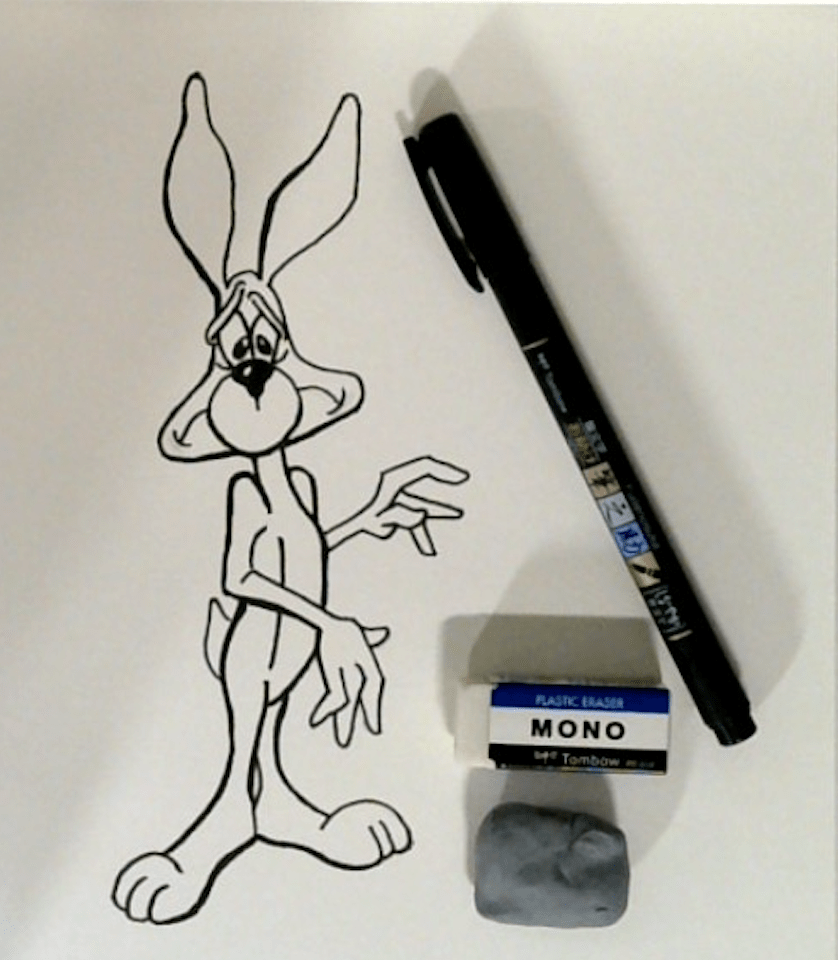
After I draw over the pencil drawing with black ink, I use a Tombow Mono white plastic eraser to remove any the remaining pencil marks. This eraser is very gentle on the paper surface and doesn’t seem to dull or remove any of the inked work.

At this point, I’m not really happy with my inking work, so far. It’s a matter of continued practice and lots more practice. In general, pencil drawn lines are mostly uniformed where ink drawn lines are variable based on building a more 3-D solid surface. It includes the direction of the shining light and the physical weight of the character.

I have to work on controlling my stroke directions and producing a better job of getting line variations. Inking should flow up and away with the natural motion of my arm and elbow. I also need to try to use my little finger as a surface support as a guide to the distance from the brush to the paper surface. This helps me to control the surface pressure of my pen. Like I said, it’s doing several new things beyond pencil drawing that only get inked with lots of practice. I’m mostly just talking to myself as a reminder.
Always love the strong Looney Tunes vibe
It’s really good to hear from you. I appreciate comments, unfortunately I don’t get many comments. This is my journal where I am working on getting back into traditional cartooning techniques. I love working digitally, but I miss the classical methods. I hope you will come by often and check me out. Yes, Chuck Jones and Friz Freleng were always big influences for me. Also, Walt Kelly’s Pogo was my favorite in the newspapers when I was a kid. Hopefully you will enjoy my upcoming practices relearning drawing Walt Kelly style works. There are almost no drawings of un-inked Walt Kelly Pogo so I am trying to reverse the process which hopefully will help me and other learning cartoonists as I practice. It is really sad that in his time, Walt Kelly never was able to directly help young cartoonist his techniques. Thanks again for stopping by.