This next series of drawings are intended to work on some basic composition issues.

For this typical example panel seen above, I chose a frame of 7 – 3/4″ high by 4 3/4″ wide. Here we see two characters interacting in a intermediate view. The comic page I normally use is 11″ – 17″ paper (for inking I use Bristol Board paper as shown below).

Panel frames for any chosen page layout can vary depending on the flow and story. As shown below there are many variations possible. It’s almost arbitrary.

Panel heights and widths are individually chosen based on each page’s requirements.
Readers Note : For panels, the relative positions of characters can be easily handled digitally by overlaying and placing objects on independent layers as well as by easy scaling adjustments. But, in the non-digital world, each frame must be planned and drawn accordingly.
An important set of tools used to solve the frame puzzle are thumbnails and possible sketches. They are used to explore ideas and plan out compositions for each individual panel.

I normally start out making some sketches of characters like Talbot and Griffon. I often like to work at a comfortable size and then I can re-sketch for the desired panel size as required. One tool that I use often is a proportional divider. It lets me re-scale proportionally a previous drawn sketch to re-draw for the required panel.

Reader Notes: Scaling is easily done in the digital world, but scaling in the traditional drawing world requires considerable effort and thought . In page panels, things close up are shown larger and they are shown smaller moving into the distance. It’s all about perspective. In the digital world, I can draw objects like my characters fairly as large as I want and then easily scale the character appropriately to fit into the size required to suit my chosen panel, it’s wonderful. But ,in the traditional world, I have to decide the panel requirements first and then draw everything appropriately ( Examples : close-up, intermediate, wide angle, etc).
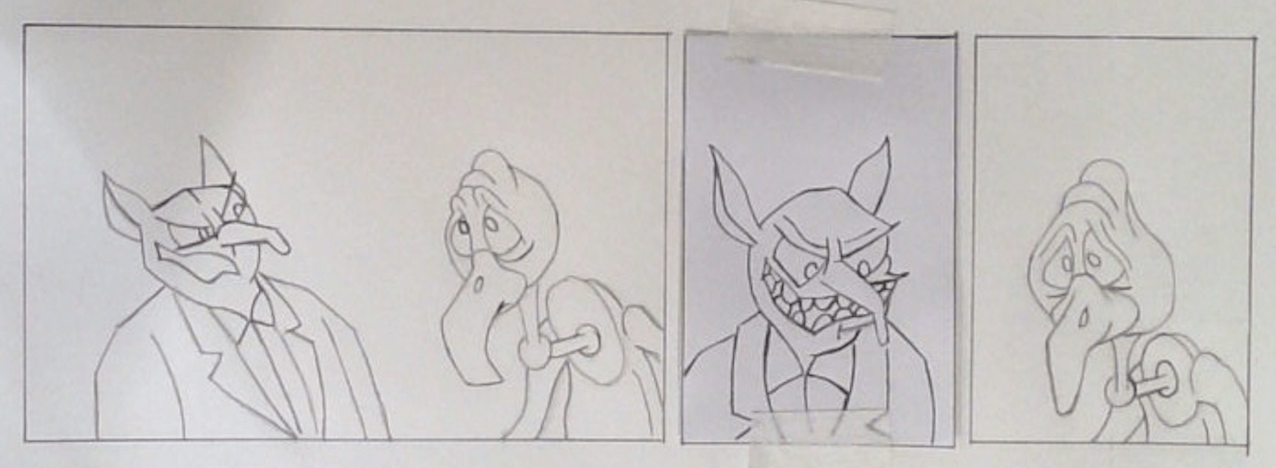
For this test example, I selected three panels, all 3 – 1/2″ high (panel 1) 5 – 3/8″ wide and (Panels 2 &3) 3 – 3/8″ wide each. The first panel is an intermediate shot of Talbot and Griffon. The 2nd panel is a close up of Talbot. The third panel also is a close up of Griffon. Typical dialog : (Panel 1) “Take your punish …” – “Not that ?” (Panel 2) “I’m waiting …” (Panel 3) “always the closet of tears“.
I had to rework panel 2 several attempts and finally replaced the original drawing attempts with a pasted in new drawing. Yes, in cartooning, the real world of pencil and paper is sometimes a lot like “the closet of tears”.
I will come back to the topic later. I really want to start working on my inking practice next.